Of course, it comes with eligibility requirements...
more here
Saturday, September 13, 2008
Friday, March 10, 2006
US Dept. Of Educations "Katrina Specific" Help Website
The Dept. Of Education has set up a website specifically for those affected Hurricane Katrina.
Some of the topics are:
How to Get Help
Donate and Volunteer
Finding Friends and Information
Health and Safety
Hurricane Contracting Information Center
White House Hurricane Relief
Additional Resources
Some of the topics are:
How to Get Help
Donate and Volunteer
Finding Friends and Information
Health and Safety
Hurricane Contracting Information Center
White House Hurricane Relief
Additional Resources


Thursday, March 09, 2006
Interest Rate Increase Closing In
Thinking about consolidating your student loan debt? You have until June 30, 2006, before new interest rates kick in. However, if you are a new graduate, you'll want to weigh the pros and cons of consolidation loans fairly quickly. After graduation, you have a six-month grace period before the loan payments begin. By consolidating during the grace period, you save about one-half a percentage point. A summer 2005 graduate could lock in a 4.7 percent rate on Stafford loans, rather than the 5.3 percent rate that kicks in at the start of the repayment period.
The only drawback to consolidating during your grace period is you'll need to start making payments immediately. Not ready to give up those blissful, payment-free months? You could keep much of your grace period by waiting to consolidate until the last month of the grace period..
With a federal consolidation loan, your lender pays off the balances of all the loans you choose to consolidate and then issues you a new loan. Keep in mind though that once you consolidate your loans, there's no going back.
"Once you consolidate there is no way to un-consolidate," says Patricia Scherschel, vice president of loan consolidation at Sallie Mae. "Consolidation is a one-way street."
The interest rate on a consolidation loan is determined by taking the weighted average of interest rates on the federal education loans the student has and rounding up to the nearest one-eighth of a percentage point, capped at 8.25 percent. The final rate will differ from student to student.
Many borrowers sign on for a consolidation loan because they need more breathing room in their monthly budgets. A consolidation loan can lower a borrower's monthly loan payment by as much as 40 percent while stretching out the repayment period.
If your student loan payments add up to more than 8 percent of your gross monthly salary, you're a good candidate for a consolidation loan.
And you don't need multiple loans to enjoy the benefits of a consolidation loan. If your loan amount is high enough, typically $7,500 or more, you may be able to consolidate a single loan. Even though the initial interest rate on that loan won't change much, it will lock in these lower rates for the life of the loan.
The only drawback to consolidating during your grace period is you'll need to start making payments immediately. Not ready to give up those blissful, payment-free months? You could keep much of your grace period by waiting to consolidate until the last month of the grace period..
With a federal consolidation loan, your lender pays off the balances of all the loans you choose to consolidate and then issues you a new loan. Keep in mind though that once you consolidate your loans, there's no going back.
"Once you consolidate there is no way to un-consolidate," says Patricia Scherschel, vice president of loan consolidation at Sallie Mae. "Consolidation is a one-way street."
The interest rate on a consolidation loan is determined by taking the weighted average of interest rates on the federal education loans the student has and rounding up to the nearest one-eighth of a percentage point, capped at 8.25 percent. The final rate will differ from student to student.
Many borrowers sign on for a consolidation loan because they need more breathing room in their monthly budgets. A consolidation loan can lower a borrower's monthly loan payment by as much as 40 percent while stretching out the repayment period.
If your student loan payments add up to more than 8 percent of your gross monthly salary, you're a good candidate for a consolidation loan.
And you don't need multiple loans to enjoy the benefits of a consolidation loan. If your loan amount is high enough, typically $7,500 or more, you may be able to consolidate a single loan. Even though the initial interest rate on that loan won't change much, it will lock in these lower rates for the life of the loan.
Wednesday, March 08, 2006
Forbearance Issues
I received this email from Cody of Houston, TX recently regarding his student loan:
"Manny - found your blog. I want to know if others are having the same problems with the Direct Loan Servicing Federal Student Aid program.
I live in Houston where I had a few leaves blown off my tree by Rita. The government automatically deferred my student loan payments without my consent. I accrued two months of interest on my balance amounting to about $200. Upon the restart of my payments, my monthly payment went up by $7/month with 72 months to go. Cumulatively, this would amount to roughly $510 of payments on $200 of accrued interest though my interest rate had not changed from the 4 5/8% it was previously. When I raised this red flag to the DLS, they stated that my loan had been miscalculated from the get-go and this was the new payment.
I called B.S. and have requested paperwork on the loan recalculation be sent to me in writing.
Please let me know if you hear of other cases."
Thanks for sharing your experience Cody. Mandatory forbearance (automatically granting forbearance) is not unheard of in times of disaster. But I was under the impression that one still had to request it, or at least sign some kind of written agreement. The whole thing sounds like a big mistake to me, but I think you did the right thing by requesting proof of their claims.
Please keep me updated, I would like to know how everything turns out.
Manny
"Manny - found your blog. I want to know if others are having the same problems with the Direct Loan Servicing Federal Student Aid program.
I live in Houston where I had a few leaves blown off my tree by Rita. The government automatically deferred my student loan payments without my consent. I accrued two months of interest on my balance amounting to about $200. Upon the restart of my payments, my monthly payment went up by $7/month with 72 months to go. Cumulatively, this would amount to roughly $510 of payments on $200 of accrued interest though my interest rate had not changed from the 4 5/8% it was previously. When I raised this red flag to the DLS, they stated that my loan had been miscalculated from the get-go and this was the new payment.
I called B.S. and have requested paperwork on the loan recalculation be sent to me in writing.
Please let me know if you hear of other cases."
Thanks for sharing your experience Cody. Mandatory forbearance (automatically granting forbearance) is not unheard of in times of disaster. But I was under the impression that one still had to request it, or at least sign some kind of written agreement. The whole thing sounds like a big mistake to me, but I think you did the right thing by requesting proof of their claims.
Please keep me updated, I would like to know how everything turns out.
Manny
Tuesday, March 07, 2006
Where Are My Student Loans?
Can't remember where you got your loan? Use this Loan Locator.
All you need is your Social Security No. and your date of birth to get the info for your primary loan contact.
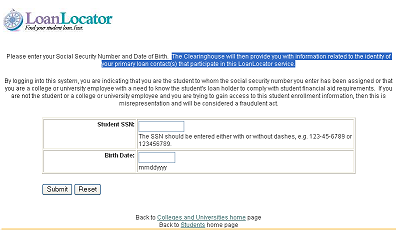
All you need is your Social Security No. and your date of birth to get the info for your primary loan contact.
Monday, March 06, 2006
Going Back To School
It is now easy to restore your eligibility to receive additional Title IV federal financial aid. Basically, your options are:
Since defaulted student loans have no statute of limitations for enforceability, you would remain ineligible for additional federal financial aid until you complete one of the options mentioned above.
Repay or satisfy the loan in full.
Make six agreed-upon monthly payments over a six month period. Your payment amount must be approved in advance by the Department. Every qualifying payment must be timely (received before the due date) and you cannot make all six payments as a single lump sum payment. Once your eligibility to receive additional federal financial aid has been restored after making six consecutive monthly payments, you must continue to make timely monthly payments to maintain your eligibility or else it will be permanently lost until the debt is resolved entirely. In other words, you may qualify for this program only once.
Consolidate your loan through the FFEL loan consolidation program or the William D. Ford Direct Loan Program.
Rehabilitate your loan through the FSA loan rehabilitation program.
Since defaulted student loans have no statute of limitations for enforceability, you would remain ineligible for additional federal financial aid until you complete one of the options mentioned above.
Sunday, March 05, 2006
Defaulted Student Loans
If you default on your student loan, the maturity date of each promissory note is accelerated making payment in full immediately due, and you are no longer eligible for any type of deferment or forbearance. Continued failure to repay a loan in default may lead to several negative consequences for you over the long-term including having your wages garnished, your Federal income tax withheld, and losing your eligibility for other federal loans like FHA or VA.
However, there are now more ways than ever before to repay your defaulted student loan and certain programs even can even remove your loan from its defaulted status. Determining which repayment option that is right for you depends on what your objective is.
All guaranty agencies and the U.S. Department of Education (ED) will accept regular monthly payments that are both reasonable to the agency and affordable to you. You should call 1-800-621-3115 (US Dept. Of Education)and one of customer service representatives will assist you with determining a repayment amount that is right for you.
Please see Going Back to School for more information on this topic.
Your options for reinstating your eligibility to receive a HUD (FHA) or VA loan are: repay or satisfy the loan in full; consolidate your loan through the FFEL loan consolidation program or the William D. Ford Direct Loan Program; or rehabilitate your loan through our loan rehabilitation program. Since defaulted student loans have no statute of limitations for enforceability, you would remain ineligible to receive a HUD or VA loan until you complete one of the options mentioned above.
If you want all negative credit reports made by the Department to your credit record, you must successfully complete the loan rehabilitation program.
Absolutely. They accept American Express, Discover, Master Card and Visa as repayment options. To repay a loan by credit card, please call the Department of Education at 1-800-621-3115.
What address do I send my payments to?
If you have a defaulted student loan held by the Department of Education, you can mail a check or money order to the address below. If you are at all unsure about the status of your loan, or who currently holds your loan, please call first at 1-800-621-3115 before sending in payment. You may also use Loan Locator to help you find out what lenders currently hold your loan(s).
National Payment Center
P.O. Box 4169
Greenville, TX 75403-4169
However, there are now more ways than ever before to repay your defaulted student loan and certain programs even can even remove your loan from its defaulted status. Determining which repayment option that is right for you depends on what your objective is.
"I want to pay my defaulted student loan in monthly payments that are affordable to me."
All guaranty agencies and the U.S. Department of Education (ED) will accept regular monthly payments that are both reasonable to the agency and affordable to you. You should call 1-800-621-3115 (US Dept. Of Education)and one of customer service representatives will assist you with determining a repayment amount that is right for you.
"I want to reestablish my eligibility for additional federal financial aid and go back to school."
Please see Going Back to School for more information on this topic.
"I'm applying for a HUD (FHA) or VA loan and I don't qualify because of my defaulted student loan."
Your options for reinstating your eligibility to receive a HUD (FHA) or VA loan are: repay or satisfy the loan in full; consolidate your loan through the FFEL loan consolidation program or the William D. Ford Direct Loan Program; or rehabilitate your loan through our loan rehabilitation program. Since defaulted student loans have no statute of limitations for enforceability, you would remain ineligible to receive a HUD or VA loan until you complete one of the options mentioned above.
"My credit record is tarnished because of my defaulted student loan. Is there anything that I can do to improve my credit record?"Failure to repay your defaulted student loan can be damaging to your credit record. In fact, consumer reporting agencies may continue to report an account for 7 years from the opening date. However, there are several things that you can do to at least partially, and in some cases, fully restore your credit record. Your options for bettering your credit report include: repay or satisfy the loan in full; consolidate your loan through the FFEL loan consolidation program or the William D. Ford Direct Loan Program; or rehabilitate your loan through the FSA loan rehabilitation program.
If you want all negative credit reports made by the Department to your credit record, you must successfully complete the loan rehabilitation program.
"Can I pay my defaulted student loan held by the Department by credit card?"
Absolutely. They accept American Express, Discover, Master Card and Visa as repayment options. To repay a loan by credit card, please call the Department of Education at 1-800-621-3115.
What address do I send my payments to?
If you have a defaulted student loan held by the Department of Education, you can mail a check or money order to the address below. If you are at all unsure about the status of your loan, or who currently holds your loan, please call first at 1-800-621-3115 before sending in payment. You may also use Loan Locator to help you find out what lenders currently hold your loan(s).
National Payment Center
P.O. Box 4169
Greenville, TX 75403-4169
Thursday, March 02, 2006
Federal Student Financial Aid Deadlines
The 2005-2006 School Year (July 1st, 2005 - June 30th, 2006):
FAFSA on the Web, Renewal FAFSA on the Web, and applications must be submitted by midnight Central Daylight time, June 30, 2006.
Corrections on the Web forms must be submitted by midnight Central Daylight time, September 15, 2006.
The 2006-2007 School Year (July 1st, 2006 - June 30th, 2007):
FAFSA on the Web, Renewal FAFSA on the Web, and applications must be submitted by midnight Central Daylight time, July 2, 2007.
Corrections on the Web forms must be submitted by midnight Central Daylight time, September 17, 2007.
More
FAFSA on the Web, Renewal FAFSA on the Web, and applications must be submitted by midnight Central Daylight time, June 30, 2006.
Corrections on the Web forms must be submitted by midnight Central Daylight time, September 15, 2006.
The 2006-2007 School Year (July 1st, 2006 - June 30th, 2007):
FAFSA on the Web, Renewal FAFSA on the Web, and applications must be submitted by midnight Central Daylight time, July 2, 2007.
Corrections on the Web forms must be submitted by midnight Central Daylight time, September 17, 2007.
More
Wednesday, March 01, 2006
Deferment, forebearance and other temporary relief
If you have trouble making your education loan payments, contact immediately the organization that services your loan. You might qualify for a deferment, forbearance, or other form of payment relief. It's important to take action before you are charged late fees. For Federal Perkins Loans, contact your loan servicer or the school that made you the loan. For FFEL Loans, contact the lender or agency that holds your loan. For Direct Loans, contact the Direct Loan Servicing Center at www.dl.ed.gov or by calling 1-800-848-0979 or 1-315-738-6634. TTY users should call 1-800-848-0983.
Deferment: You can receive a deferment for certain defined periods. A deferment is a temporary suspension of loan payments for specific situations such as reenrollment in school, unemployment, or economic hardship. For a list of deferments, click here. You don’t have to pay interest on the loan during deferment if you have a subsidized FFEL or Direct Stafford Loan or a Federal Perkins Loan. If you have an unsubsidized FFEL or Direct Stafford Loan, you’re responsible for the interest during deferment. If you don’t pay the interest as it accrues (accumulates), it will be capitalized (added to the loan principal), and the amount you have to pay in the future will be higher. You have to apply for a deferment to your loan servicer (the organization that handles your loan), and you must continue to make payments until you’ve been notified your deferment has been granted. Otherwise, you could become delinquent or go into default.
Forbearance: Forbearance is a temporary postponement or reduction of payments for a period of time because you are experiencing financial difficulty. You can receive forbearance if you’re not eligible for a deferment. Unlike deferment, whether your loans are subsidized or unsubsidized, interest accrues, and you’re responsible for repaying it. Your loan holder can grant forbearance in intervals of up to 12 months at a time for up to 3 years. You have to apply to your loan servicer for forbearance, and you must continue to make payments until you've been notified your forbearance has been granted.
Note to PLUS Loan borrowers: Generally, the same eligibility requirements and procedures for requesting a deferment or forbearance that apply to Stafford Loan borrowers also apply to you. However, since all PLUS Loans are unsubsidized, you'll be charged interest during periods of deferment or forbearance. If you don't pay the interest as it accrues, it will be capitalized (added to the principal balance of the loan), thereby increasing the amount you'll have to repay.
Other forms of payment relief: Graduated and income-sensitive repayment plans are available. Graduated payment plans provide short-term relief through low interest-only payments followed by a gradual increase in payments (usually every two years). An income-sensitive payment plan offers borrowers payments based on yearly income. As that rises and falls, so do the payments.
Deferment: You can receive a deferment for certain defined periods. A deferment is a temporary suspension of loan payments for specific situations such as reenrollment in school, unemployment, or economic hardship. For a list of deferments, click here. You don’t have to pay interest on the loan during deferment if you have a subsidized FFEL or Direct Stafford Loan or a Federal Perkins Loan. If you have an unsubsidized FFEL or Direct Stafford Loan, you’re responsible for the interest during deferment. If you don’t pay the interest as it accrues (accumulates), it will be capitalized (added to the loan principal), and the amount you have to pay in the future will be higher. You have to apply for a deferment to your loan servicer (the organization that handles your loan), and you must continue to make payments until you’ve been notified your deferment has been granted. Otherwise, you could become delinquent or go into default.
Forbearance: Forbearance is a temporary postponement or reduction of payments for a period of time because you are experiencing financial difficulty. You can receive forbearance if you’re not eligible for a deferment. Unlike deferment, whether your loans are subsidized or unsubsidized, interest accrues, and you’re responsible for repaying it. Your loan holder can grant forbearance in intervals of up to 12 months at a time for up to 3 years. You have to apply to your loan servicer for forbearance, and you must continue to make payments until you've been notified your forbearance has been granted.
Note to PLUS Loan borrowers: Generally, the same eligibility requirements and procedures for requesting a deferment or forbearance that apply to Stafford Loan borrowers also apply to you. However, since all PLUS Loans are unsubsidized, you'll be charged interest during periods of deferment or forbearance. If you don't pay the interest as it accrues, it will be capitalized (added to the principal balance of the loan), thereby increasing the amount you'll have to repay.
Other forms of payment relief: Graduated and income-sensitive repayment plans are available. Graduated payment plans provide short-term relief through low interest-only payments followed by a gradual increase in payments (usually every two years). An income-sensitive payment plan offers borrowers payments based on yearly income. As that rises and falls, so do the payments.
Tuesday, January 03, 2006
Repaying Your Student Loans Publication
 You’ve attended college or received other education beyond high school, and you received federal student loans from the US Department of Education (ED) along the way. You’re now about to deal with paying them back. You’ll need to know how to manage your student loan debt to avoid repayment problems. This publication explains available repayment options so you can successfully repay your debt. It will also tell you what steps to take so you won’t get behind in payments or go into default.
Federal student loans are real loans, just like car loans or mortgage loans. You can’t just get out of repaying a student loan if your financial circumstances become difficult, unless you qualify for bankruptcy. But, it’s very difficult to have federal student loans discharged in bankruptcy; this happens only rarely. Also, you can’t cancel your student loans if you didn’t get the education you expected, didn’t get the job you expected, or didn’t complete your education, unless you leave school for a reason that qualifies you for a discharge of your loan. Remember, your student loans belong to you; you have to pay them back.
Available in .pdf format (you will need adobe acrobat reader)
Download English Version
Download Spanish Version
Tuesday, October 04, 2005
Hurricane Relief Loan
Sallie Mae is offering an interest-free loan to students displaced by Hurricane Katrina. The loan is a one-time relief loan of up to $1,000.00. Students may apply for the loan through December 31, 2005. The loan is interest-free through May 31, 2006.
qualifying info here
qualifying info here
Saturday, September 17, 2005
New Federal Consolidation Loan interest rates have increased
From http://www.federalconsolidation.org/
Notice: New Federal Consolidation Loan interest rates have increased. Today's rate: 4.750%.
"What if I didn't apply before July 1, 2005"?
Answer: If you apply on or after July 1, 2005 the weighted average interest rate on your consolidation loan will be calculated using the higher interest rate (currently 4.750%*). Federal regulations set when this higher rate goes into effect. You may still choose to consolidate at this higher rate, however you should weight the pros and cons carefully before deciding whether to consolidate.
* This is the consolidation interest rate on Federal Stafford Loans originally borrowed after 1998 and consolidated while in school or grace.
Notice: New Federal Consolidation Loan interest rates have increased. Today's rate: 4.750%.
"What if I didn't apply before July 1, 2005"?
Answer: If you apply on or after July 1, 2005 the weighted average interest rate on your consolidation loan will be calculated using the higher interest rate (currently 4.750%*). Federal regulations set when this higher rate goes into effect. You may still choose to consolidate at this higher rate, however you should weight the pros and cons carefully before deciding whether to consolidate.
* This is the consolidation interest rate on Federal Stafford Loans originally borrowed after 1998 and consolidated while in school or grace.
Thursday, September 15, 2005
FAFSA correction deadline
Deadlines: The 2004-2005 FAFSA correction deadline was today (September 15, 2005). However, if you have been affected by Hurricane Katrina, the correction deadline has been extended until December 1, 2005. Corrections must be submitted by midnight Central time on the deadline date. midnight Central Daylight time, September 15, 2005. -->Submit 2005-2006 FAFSA on the Web Applications by midnight Central Daylight time, June 30, 2006.
Friday, September 09, 2005
Student Loan Resources Page
Cingular Motorola Rokr with Itunes
The lowest prices for cell phones from all major carriers. Premium phones like the Motorola Razr and Rokr are free with a new service agreement. All phones include Free Shipping. We even have free phone upgrades for existing Cingular customers.
Quit Smoking Programs
Top 4 Quit Smoking Courses Reviewed. Detailed Reviews and Comparisons.
Free Articles, Resources, And Information About Credit Repair
If You Would Like To Learn How To Repair Your Credit And Consolidate Your Debt, You've Come To The Right Place. Welcome To CreditRepairSite4U.com. Our Free Articles, Strategies, And Resources Will Help You Make Informed Decisions About Credit Repair
Sedu Hairstyle Tips
Become the envy of the rest by sporting super attractive sedu hairstyles that don't take half a day to get done.
mannys 2 cents
Affiliate Program
Become a super affiliate with 100% free training from the most successful affiliate marketers in the world only at TheSecondTier.com
The lowest prices for cell phones from all major carriers. Premium phones like the Motorola Razr and Rokr are free with a new service agreement. All phones include Free Shipping. We even have free phone upgrades for existing Cingular customers.
Quit Smoking Programs
Top 4 Quit Smoking Courses Reviewed. Detailed Reviews and Comparisons.
Free Articles, Resources, And Information About Credit Repair
If You Would Like To Learn How To Repair Your Credit And Consolidate Your Debt, You've Come To The Right Place. Welcome To CreditRepairSite4U.com. Our Free Articles, Strategies, And Resources Will Help You Make Informed Decisions About Credit Repair
Sedu Hairstyle Tips
Become the envy of the rest by sporting super attractive sedu hairstyles that don't take half a day to get done.
mannys 2 cents
Affiliate Program
Become a super affiliate with 100% free training from the most successful affiliate marketers in the world only at TheSecondTier.com
Thursday, September 08, 2005
Student Debt "Increasingly Unmanageable"
CNN Money Online
Article Highlights:
In 1999-2000, 64 percent of students graduated with student loan debt; average student debt has nearly doubled during the last eight years to $16,928.
Read all about it here
Article Highlights:
In 1999-2000, 64 percent of students graduated with student loan debt; average student debt has nearly doubled during the last eight years to $16,928.
Read all about it here
Canadian College Student Statistics
A statistical report from Canada about students and the factors that contribute to their ability to pay their student loan debt-
Read all about it here
Read all about it here
One British College Graduates Experience
I Found this interesting article about a British graduate named Joanna Kelly. Like a lot of college grads who had the misfortune of not being born with a silver spoon in her mouth, she finds herself deep in debt with seemingly no light at the end of the perverbial tunnel.
I just love the way the 2 "financial advisors" pelt her with GENERAL INFO (are you sensing my sarcasm here?)
Read all about it here
I just love the way the 2 "financial advisors" pelt her with GENERAL INFO (are you sensing my sarcasm here?)
Read all about it here
Wednesday, September 07, 2005
Consolidate Student Loans OR Upromise: Help Paying Off Your American Education Services (AES) Loan
Launched in April 2001, Upromise was created to help families save for college. By joining forces with some of America's leading companies, Upromise allows families to get back a percentage of their everyday spending into their Upromise accounts.
Upromise has built a simple way to help families learn more about their savings options, open investment accounts, and jumpstart their savings. The mission of Upromise is to make college more affordable for American families.
Simply join Upromise for free and leading companies will contribute a portion of what you spend with them into your Upromise account. You can then use these funds to help pay off your AES education loan. You can even invite family and friends to join Upromise and help pay off your school loans. There's never been a better way to manage your educational expenses.
Eligibility and requirements here.
Upromise has built a simple way to help families learn more about their savings options, open investment accounts, and jumpstart their savings. The mission of Upromise is to make college more affordable for American families.
Simply join Upromise for free and leading companies will contribute a portion of what you spend with them into your Upromise account. You can then use these funds to help pay off your AES education loan. You can even invite family and friends to join Upromise and help pay off your school loans. There's never been a better way to manage your educational expenses.
Eligibility and requirements here.
TO GO OR NOT TO GO- to college
I personally feel that people today put more emphasis on college and higher education than on quality time with their family and living a simple lifestyle. If your parents happen to be well-to-do, going to college may not really be a big deal. But if you are from a family of lesser means, college will certainly take it's toll on you and your household. Consider this:
I think people are being pulled-in by all of the "go to college for a better life" propaganda out there (by the way, this propaganda is instigated by slave-drivers in order to determine which slaves would work harder and longer). I'm not saying that college in itself is completely wrong and if you go you are a dummy. But I think that "keeping your eye simple" and putting family first is in order.
Instead of being taught how to live with less, "go for the gusto" is the phrase of the day. For instance, read this article I found and notice how there is no mention of "family time" and the parents don't say anything like "there is nothing wrong with driving a Chevrolet instead of a BMW". There arguement for the kid to go to college is based solely on MAKE MORE MONEY. This is the kind of stuff that makes people today feel almost obligated to "Make something of themselves" (which actually means, you make your Maserati driving employer richer and your BMW driving self gets to look down on all of those Chevrolet driving simpletons out there).
Of course, if you have the means to go to college or plan to be single until your loans are paid off, more power to you. But always remember that college is not the "end word".
Written by Manny,
a self-employed publisher who did not go to college and is not rich
(but is very happy and spends most of his time with his family)
- If you marry while still paying on your student loans, odds are that your marriage will be full of tension due to financial difficulties- especially if both husband and wife come into the marriage owing on college loans.
- Now add the pitter-patter of little feet to the scenario....
I think people are being pulled-in by all of the "go to college for a better life" propaganda out there (by the way, this propaganda is instigated by slave-drivers in order to determine which slaves would work harder and longer). I'm not saying that college in itself is completely wrong and if you go you are a dummy. But I think that "keeping your eye simple" and putting family first is in order.
Instead of being taught how to live with less, "go for the gusto" is the phrase of the day. For instance, read this article I found and notice how there is no mention of "family time" and the parents don't say anything like "there is nothing wrong with driving a Chevrolet instead of a BMW". There arguement for the kid to go to college is based solely on MAKE MORE MONEY. This is the kind of stuff that makes people today feel almost obligated to "Make something of themselves" (which actually means, you make your Maserati driving employer richer and your BMW driving self gets to look down on all of those Chevrolet driving simpletons out there).
Of course, if you have the means to go to college or plan to be single until your loans are paid off, more power to you. But always remember that college is not the "end word".
Written by Manny,
a self-employed publisher who did not go to college and is not rich
(but is very happy and spends most of his time with his family)
Wednesday, August 31, 2005
The federal Perkins Loan
The Perkins Loan is awarded to undergraduate and graduate students with exceptional financial need. This is a campus-based loan program, with the school acting as the lender using a limited pool of funds provided by the federal government. (The Perkins Loan is the best student loan available. It is a subsidized loan, with the interest being paid by the federal government during the in-school and 9-month grace periods. There are no origination or guarantee fees, and the interest rate is 5%. There is a 10-year repayment period.
The amount of Perkins Loan you receive is determined by your school's financial aid office. The program limits are $4,000 per year for undergraduate students and $6,000 per year for graduate students, with cumulative limits of $20,000 for undergraduate loans and $40,000 for undergraduate and graduate loans combined.
Institutions participating in the Expanded Lending Option (ELO) may offer higher loan limits for the Perkins Loan. To participate in the ELO, a school must have a default rate no higher than 15%. The annual loan limits are increased by $1,000 each and the cumulative limits increased by $5,000 and $10,000, respectively.
The Perkins Loan also offers better cancellation provisions than the Stafford or PLUS loans. See the section on loan forgiveness for more details.
To apply for a Stafford Loan, you must submit the Free Application for Federal Student Aid (FAFSA). Even though the unsubsidized Stafford Loan is available to all students regardless of financial need, you must still submit the FASFA to be eligible. You can receive a subsidized loan and an unsubsidized loan for the same period.
You may use the Lender Codes Database to obtain the lender codes of participating student loan providers. FinAid also maintains a list of education lenders who offer federal and private student loans. If you are a student attending a school that participates in the Federal Direct Student Loan Program you will obtain your federal student loan funds directly from the U.S. government, not from private lenders.
The amount of Perkins Loan you receive is determined by your school's financial aid office. The program limits are $4,000 per year for undergraduate students and $6,000 per year for graduate students, with cumulative limits of $20,000 for undergraduate loans and $40,000 for undergraduate and graduate loans combined.
Institutions participating in the Expanded Lending Option (ELO) may offer higher loan limits for the Perkins Loan. To participate in the ELO, a school must have a default rate no higher than 15%. The annual loan limits are increased by $1,000 each and the cumulative limits increased by $5,000 and $10,000, respectively.
The Perkins Loan also offers better cancellation provisions than the Stafford or PLUS loans. See the section on loan forgiveness for more details.
To apply for a Stafford Loan, you must submit the Free Application for Federal Student Aid (FAFSA). Even though the unsubsidized Stafford Loan is available to all students regardless of financial need, you must still submit the FASFA to be eligible. You can receive a subsidized loan and an unsubsidized loan for the same period.
You may use the Lender Codes Database to obtain the lender codes of participating student loan providers. FinAid also maintains a list of education lenders who offer federal and private student loans. If you are a student attending a school that participates in the Federal Direct Student Loan Program you will obtain your federal student loan funds directly from the U.S. government, not from private lenders.
Subscribe to:
Posts (Atom)